
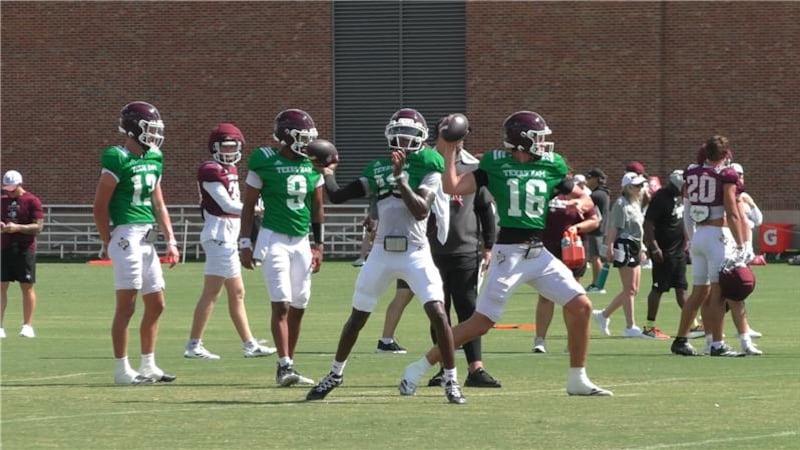
Members of the Texas A&M football team practice passing and receiving during a training session.
The college football landscape is bracing for what could be its most expensive transfer season yet. As 2026 approaches, universities are preparing to open their wallets wider than ever before, with industry experts predicting that Name, Image, and Likeness (NIL) spending during the transfer portal window could eclipse all previous records.
The Financial Revolution
The transformation of college football’s financial ecosystem has been nothing short of revolutionary. Programs that once relied solely on traditional recruiting are now navigating a professional-style free agency market. Yahoo Sports recently reported that LSU has committed to spending $25-30 million annually on roster construction through revenue sharing and NIL funds for new head coach Lane Kiffin—a significant jump from the $18 million spent under previous leadership.
This escalation at LSU represents a broader trend across major college football. With the NCAA’s House settlement implementation looming and revenue sharing models set to distribute approximately $20 million per school starting in 2025-2026, the total pool of money available for player compensation is expanding dramatically. When combined with booster-funded NIL collectives, the 2026 transfer portal could see total spending approach or exceed $1 billion across all FBS programs.
The New Blueprint for Success
The blueprint for success in this new era was demonstrated by Texas Tech’s remarkable 2025 season. ESPN detailed how the Red Raiders assembled “one of the greatest transfer portal classes of this evolving era,” bringing in 22 transfers who yielded 11 starters in their Big 12 championship game. This model—aggressive portal recruitment backed by substantial NIL investment—is becoming the standard rather than the exception.
The financial arms race shows no signs of slowing. Programs are increasingly viewing transfer portal spending as essential infrastructure investment rather than optional enhancement. USA TODAY Sports revealed that even programs running significant deficits, like Colorado’s projected $27 million shortfall, continue to prioritize competitive NIL spending to remain relevant in recruiting battles.
Breaking Down the Numbers
Conservative estimates suggest that the top 25 programs alone could collectively spend $500-750 million during the 2026 transfer window. The spending breakdown looks like this:
Power conference schools are averaging $15-20 million per program, while mid-tier Power Five schools are expected to allocate $8-12 million. Even Group of Five programs are budgeting $2-5 million for portal acquisitions. These figures don’t include the baseline revenue sharing payments that will become standard compensation.
Position scarcity will drive premium prices in 2026. Quarterbacks commanding $1-3 million packages are becoming routine, while elite offensive linemen and pass rushers are securing deals exceeding $500,000. The multiplication effect across 85-scholarship rosters, plus walk-on considerations, creates a staggering total expenditure.
The Regulatory Void
The lack of regulatory framework continues to fuel this spending surge. Big 12 Commissioner Brett Yormark has called the current system “uncapped spending” for NIL in football, emphasizing the urgent need for congressional action that remains stalled.
Former Alabama coach Nick Saban’s recent comments about the need for structural reform highlight the concerns many have about sustainability. Bleacher Report quoted Saban calling for a commissioner to oversee all conferences and establish uniform rules, warning about the “anarchy” in the current system as it heads into 2026.
The Ripple Effect
The ripple effects extend beyond the field. Athletic departments are scrambling to fund these new realities through increased ticket prices, seat licensing fees, and aggressive fundraising campaigns. As Yahoo Sports Canada noted, “the cost of the professionalization of college sports is becoming clear with every fundraising email, every season ticket payment plan offer, and every added charge that fans pay.”
Looking ahead to the 2026 transfer portal window, several factors suggest spending will reach unprecedented levels: the maturation of NIL collectives, the full implementation of revenue sharing, the absence of spending caps, and the increasing acceptance of college football as a professional sport in all but name.
While predicting an exact figure remains challenging given the opaque nature of NIL deals, the convergence of revenue sharing, collective fundraising, and competitive pressure points toward total transfer portal spending in the $800 million to $1.2 billion range for the 2026 cycle. This represents not just an evolution but a revolution in how college football programs build their rosters.
The 2026 transfer season will likely be remembered as a defining moment in college football history—the year when the sport fully embraced its professional reality, for better or worse. As programs prepare their war chests and players ready their representation, one thing is certain: the price of competing at the highest level has never been higher, and it’s only going up from here.
